
 Roofing Services
Why Are Commercial Roofs Flat?
If you manage a warehouse, retail center, office building, or multi-unit property, you have probably looked up and wondered: why are commercial roofs flat? It is a fair question, especially when sloped designs seem like the obvious choice for shedding water. The short answer is that flat systems make more sense for many large buildings because they are practical, cost-conscious, easier to use, and easier to service.
That said, they are not truly flat. Most have a slight slope built in so water can move toward drains, scuppers, or gutters. In other words, the term flat is more about appearance than exact design.
Why are commercial roofs flat on so many buildings?
The biggest reason is efficiency. Large commercial structures need a covering system that works well across wide spans without driving costs through the roof. A low-slope design uses fewer materials than a steep one, needs less structural support in many cases, and creates a simpler shape over a big footprint.
For a small home, a steep pitch can be a visual feature. For a shopping center, manufacturing space, or office complex, appearance usually comes second to function. Owners and property managers are focused on durability, access, equipment space, maintenance costs, and how the building performs over time.
That is why low-slope systems are so common. They are built to handle large square footage in a practical way.
Cost is a major factor
When people ask why are commercial roofs flat, cost is usually one of the first real answers. A steeply pitched design over a large commercial building often requires more framing, more covering material, and more labor. That adds up fast.
A flatter system is generally more economical to build over big spaces. There is less complexity in the shape, fewer dramatic angles, and often a more straightforward installation process. For owners balancing construction budgets, repair budgets, and long-term maintenance planning, that matters.
Lower upfront cost does not mean no upkeep. It means the design tends to be more budget-friendly for the size of the structure. If a building covers tens of thousands of square feet, even small savings per square foot can become a major difference.
Flat designs make large buildings easier to use
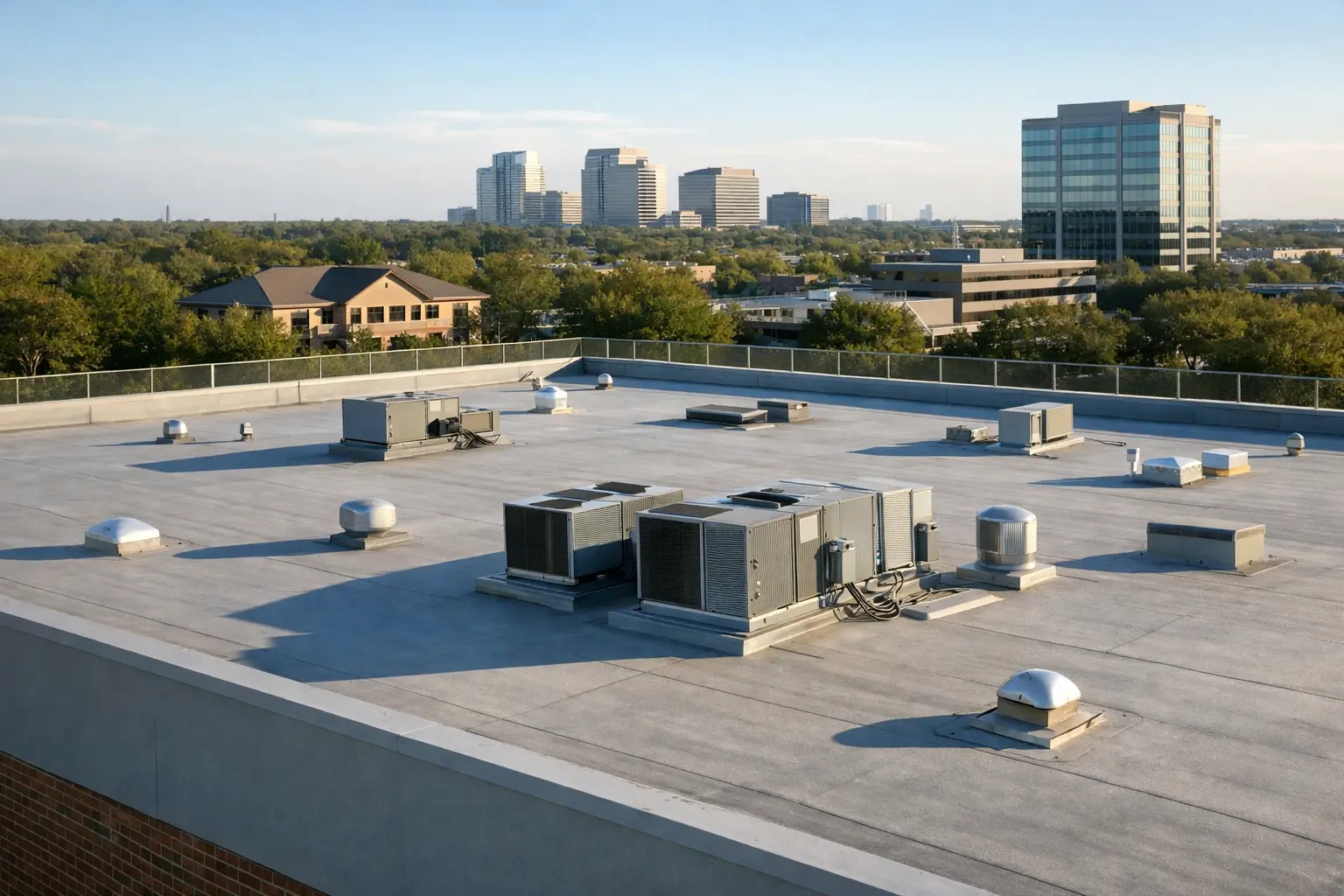
One reason commercial buildings favor low-slope systems is that the top of the building often needs to do more than just cover the space below. Businesses use that area for HVAC units, vents, electrical equipment, and other mechanical components.
A flatter surface makes that possible. Technicians can access equipment more safely and more easily than they could on a steep incline. That matters during inspections, maintenance visits, repairs, and replacements. It also helps keep equipment out of sight from the ground, which can improve the building’s overall appearance.
On some properties, the space may also support solar panels or other functional additions. That kind of flexibility is harder to achieve with steep slopes.
Drainage still matters more than people think
Some owners assume flat systems invite standing water by design. That is not how they are supposed to work. A properly built low-slope system includes a subtle pitch that directs water toward drainage points.
This is where quality work matters. If the surface is uneven, if drains are poorly placed, or if debris is allowed to build up, water can pond in the wrong areas. Over time, that can shorten the life of the system and increase the chance of leaks.
So while flat designs are practical, they are not forgiving of neglect. They need the right slope, the right drainage setup, and regular attention. In storm-prone areas with heavy rain, this becomes even more important.
Maintenance is simpler in some ways, but not optional
There is a reason so many facility managers appreciate low-slope systems. Access is easier. Inspections are easier. Service crews can move around the surface more safely than they can on a sharply pitched structure.
That convenience makes routine maintenance more manageable. Small issues like clogged drains, membrane damage, seam separation, or flashing wear can often be identified earlier because the surface is easier to walk and inspect.
Still, easy access cuts both ways. Because people can get up there more often, foot traffic can create wear if the system is not protected properly. Equipment servicing can also cause damage if crews are careless. The design helps with maintenance, but it does not replace it.
Why flat systems work well for modern commercial construction
Commercial properties are built around usable interior space. A low-slope top line supports a simple, box-like structure that maximizes room below. For offices, retail spaces, storage facilities, and industrial buildings, that is a big advantage.
A steep design would change the building’s profile and can complicate structural planning. It may also create wasted space or add design challenges that do not improve the building’s function. In most commercial settings, owners want straightforward performance, not extra complexity.
That is one of the most practical answers to why are commercial roofs flat. The shape fits the purpose of the building.
Energy performance can be part of the equation
Low-slope systems can also support energy goals, depending on the materials used and how the building is designed. Reflective surfaces can help reduce heat absorption. Space for mechanical equipment and solar installations can make energy planning more flexible.
Of course, performance depends on the full assembly, not just the slope. Insulation, surface material, drainage design, and local climate all play a part. In a hot Texas climate, heat exposure and storm resistance are both major considerations, so the system needs to be matched to the building and its use.
This is where one-size-fits-all advice falls apart. A flat design can perform very well, but only if it is built and maintained with the local environment in mind.
The trade-offs are real
Flat commercial systems make sense for many reasons, but they are not perfect for every situation. The biggest trade-off is drainage sensitivity. Since the slope is minimal, there is less room for error. Poor installation, blocked drains, or neglected maintenance can lead to water problems faster than many owners expect.
They can also require more frequent inspections than some people realize. Because issues do not always announce themselves from the ground, regular checkups matter. Seams, penetrations, flashing, and drainage points all need attention.
And while access is easier, that same access can lead to more wear from service crews, equipment work, and foot traffic. A system built for utility still needs protection.
What owners and property managers should pay attention to
If you are responsible for a commercial property, the better question may not be just why are commercial roofs flat, but whether your current system is performing the way it should. A flat or low-slope design is only as good as its installation, drainage, and maintenance plan.
Watch for standing water after storms, interior stains, bubbling or separation at the surface, visible damage around penetrations, and blocked drains or scuppers. Even small warning signs can point to bigger issues if they are ignored.
It also helps to think long-term. Commercial properties do better when maintenance is planned instead of reactive. Waiting until there is an active leak usually means the damage has already spread farther than you can see.
For owners who want one reliable contractor for property improvements, it helps to work with a team that understands how exterior systems affect the whole building. That practical, all-in-one approach can save time, reduce stress, and keep costs under control.
The real answer comes down to function
Commercial buildings are designed around performance, budget, and serviceability. That is why flat systems are so common. They are cost-effective over large areas, easier to access, well-suited for mechanical equipment, and practical for modern building design.
They also come with responsibilities. Good drainage, routine inspections, and timely repairs are what keep a flat commercial system working the way it should. If you treat it like a set-it-and-forget-it feature, problems tend to show up when they are most expensive.
For most commercial properties, flat is not a shortcut. It is a practical choice built around how businesses actually use their buildings. If your property needs expert attention, the smartest move is to catch issues early and keep the entire structure working as it should.
