
 Fence and Gate Solutions
A fence seems easy. Posts, panels, a gate, finished. And then the bids start coming in, the city wants a permit, and somebody mentions a gas line buried in the ground. It’s not that easy anymore.
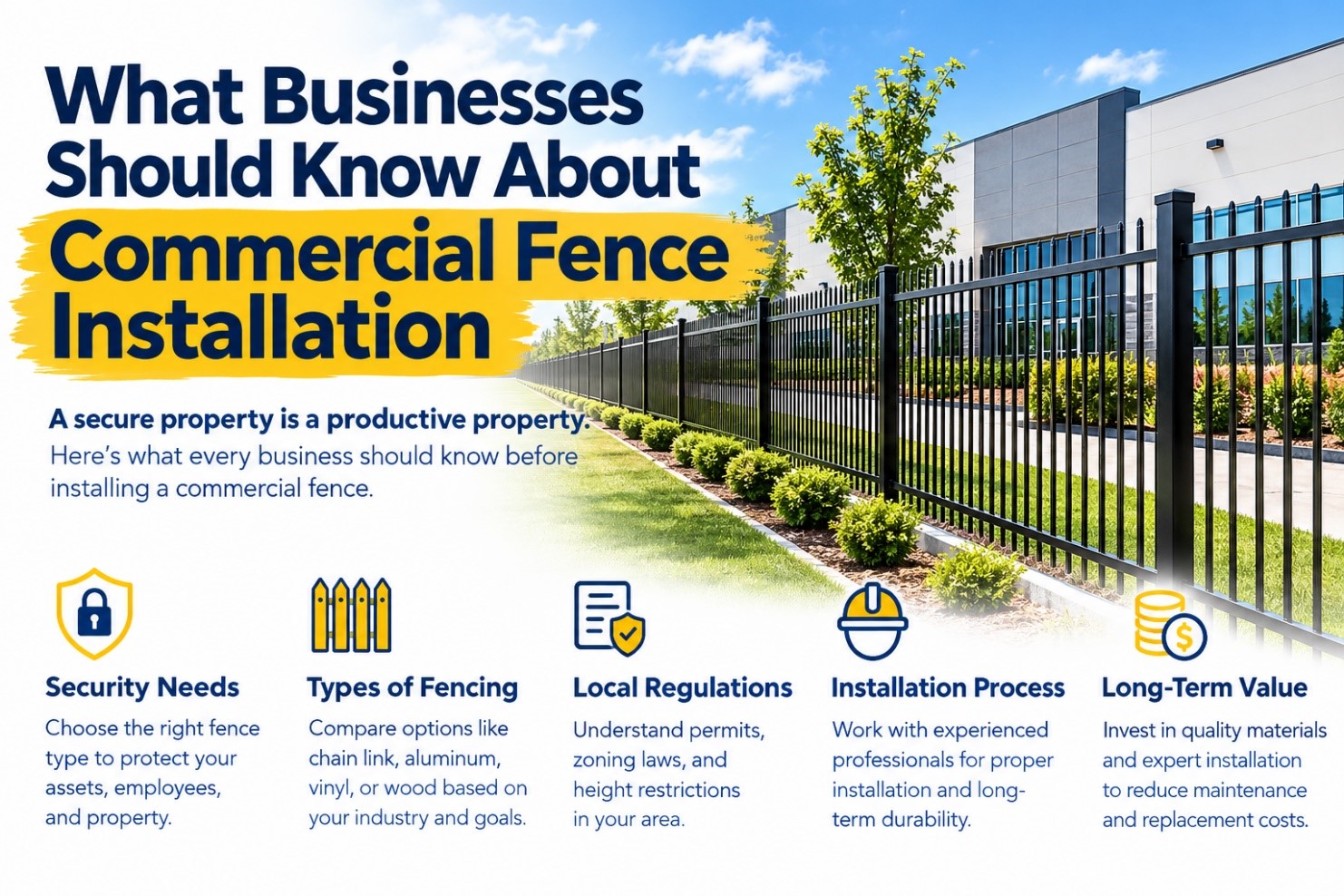
For a commercial fence installation, a little study goes a long way to save money. Choose the incorrect material and you’ll be replacing it in five years. Leave the permit, and maybe tear it down. You positioned the gate improperly, and your delivery vehicles can’t get in.
Here’s what company owners and property managers need to know before you sign on the dotted line. No walls of jargon. Only the information that counts.
Why Businesses Put Up Fences in the First Place
Every property has a story to tell. Know yours before you start buying; it determines practically everything else.
- Protection: Keeping people out of lots, yards, equipment areas and loading docks.
- Safety and liability: Blocking access to pools, retention ponds, construction areas or equipment.
- Confidentiality: Concealing dumpsters, mechanical units, or storage places from customers’ and neighbors’ views.
- Boundaries of property: Marking the end of your lot might help avoid issues later.
- Traffic management: Directing people and cars where you want them to go.
- Looks: A neat, tidy fence indicates to consumers that you care about the location.
Most firms want two or three of them going on at once. That is normal. Just rate them. A fence constructed for security is a different animal than a fence built for appearances.
Popular Types of Commercial Fencing
There is no one optimal way. There is only the correct one for your site, budget and objective.
Chain Link Fence
The workhorse. It’s inexpensive, long-lasting and fast to install. Galvanized steel is OK outside, and if you’d want color and a little more protection, go for the vinyl-coated kind. Not flashy, but it gets the job done. Many warehouses, lots, schools and industrial places employ it for good cause.
Steel or Aluminum Decorative
These seem nice. Think of sleek, vertical bars and ornamental tops. They are well suited for workplaces, medical facilities, residential complexes and retail locations where appearance is a concern.
Aluminum is resistant to rusting, while steel is often stronger. The two are more expensive than chain link.
Plastic (Vinyl)
Privacy style as a rule. Easy to maintain and neat-looking. It won’t decay or require painting. It’s not always the best option for high-security applications, so consider what you’re safeguarding.
Wood
Natural appearance and adequate privacy. But it needs more service. Staining, sealing, and periodic repairs are part of the package. Wood may wear more rapidly in moist or extremely hot situations.
Welded Wire Mesh
Strong and hard to cut. Often used for higher-security places, including utility installations, storage yards and certain industrial properties.
High Security & Anti-Climbing Options
More stringent supervision is needed for some places. Higher fences, tighter mesh, and anti-climb features might make it harder for invaders. Barbed wire and similar add-ons are not permitted everywhere, so check your local restrictions first.
Fast rule: Chain link for budget and function, decorative for curb appeal, vinyl or wood for privacy, welded or anti-climb for security. Mix and match if your property has varying demands in various areas.
The First Step Is to Know Your Property
Any other step creates greater headaches than skipping this step.
- Not sure about the boundary? Get a survey. Simply building a foot beyond the border might lead to legal difficulties with a neighbor.
- Verify zoning codes. Cities and counties typically prohibit the height, material, and location of fences, particularly near roadways or crossings.
- Verify HOA or property owner regulations. Sometimes you have standards in business parks and joint projects.
- Find information about easements. Utility providers may have access rights to particular sections of your property, which might impact where you can put a fence.
- Call 811 before you dig. This free service in the U.S. lets you locate subsurface utility lines. Striking a gas, electric or water line is both hazardous and costly. Many contractors make this call, but be sure to check who’s responsible.
A good contractor will bring these subjects up before you do. If they do not, then take it as a warning signal.
Codes & Permits
Most commercial fencing requires a permit from the municipality. Some don’t for lower fences, but higher ones, especially those near roadways, nearly always do. It differs a lot from one area to another.
Things that could have a role:
- Height restrictions: Front garden versus rear areas.
- Setback guidelines: How far from the property boundary or street the fence must be.
- Visibility regulations: Requirements at driveways and corners.
- Fire access requirements: Gates could have to open for emergency workers. Check with your local fire marshal for access, key boxes, or gate release devices.
- Accessibility guidelines: Pedestrian gates and walkways may need to fulfil ADA regulations.
contact GottaCallMAC at 936-290-3502 or visit www.gottacallmac.com
Don’t assume the contractor has the permission. Ask straight up who’s going to pull it, who’s going to pay for it and when it’s going to be authorized. Without one, you might find yourself fined or have the fence removed.
Factors That Influence Commercial Fence Installation Cost
Price is the first thing anybody asks. Okay, okay. But there is no honest single figure, since so much relies on your site.
The key cost drivers:
- Length of fence: More linear footage means more material and labor.
- Height: The taller the fence, the stronger the posts, the more material, and usually the deeper the footings.
- Materials: Chain link is generally the cheapest. Ornamental and high-security choices will tend to cost extra.
- Terrain: Slopes, pebbles, tree roots and soft earth all slow the installers down.
- Gates: A basic walk gate is inexpensive. Then there’s a whole new budget for a broad sliding or motorized vehicle gate with a keypad or card reader.
- Old fence removal: Includes tear-out and removal.
- Licenses and surveys.
- Access to the site: If the crew can’t get equipment in easily, labor goes up.
- Timing: Busy seasons bring longer delays and higher quotes.
When you enquire for quotations, obtain them in writing and itemized. It is quite difficult to compare bids when they are submitted as one lump payment.
Gates: The Part People Don’t Get
Generally, the whole project’s most complex portion is the gate. Think about it.
- How broad is it supposed to be? Delivery trucks, forklifts and emergency vehicles require space to go through.
- Swing or slide? Swing gates need operating room. Sliding gates require clearance along the fence line.
- Manual or automatic? Automatic gates provide convenience and control, but also require electricity, wiring and maintenance.
- Access control: You may add security with keypads, card readers, remotes or intercom systems. Don’t make them an afterthought or plan for them late in the game.
- Security features: Automatic gates need sensors and safety measures to avoid harm.
Later, bad gate planning becomes an everyday irritant. Good preparation fades into the background, which is precisely what you want.
How to Select a Commercial Fence Contractor
The contractor is as important as the material. A lousy fence is a terrible fence, even if it’s a fantastic fence.
Look for these:
- License and registration, if required by your state or city.
- Insurance. Ask for evidence of workers’ compensation and liability insurance. Don’t take their word for it.
- Experience in commercial activities. Residential and commercial work are two different things. Learn about comparable projects they’ve worked on.
- References. Ring a few people. Ask if the task was performed on time and within budget.
- A contract in writing. Materials, height, gate details, timeline, payment terms and warranty.
- Details of warranty. Find out what materials and labour are covered, and for how long.
- Clear communication. If they are delayed or ambiguous while giving the quotation, they will probably be the same way when doing the task.
Search for:
- Very low bids that don’t provide specifics.
- High upfront costs before any work is done.
- Pressure to sign immediately.
- Utilities not marked or permissions not mentioned.
- Vague answers on ownership.
Get three or more estimates. Compare scope, not pricing. If you choose the lower bid and it does not include gates, permits or removal, then you might pay more in the end.
What the Installation Process Usually Looks Like
No two jobs are identical, yet most go something like this:
- Site Visit and Measurements: The contractor will come out, walk the land, take note of the layout and discuss your aims.
- Quoting and Design: You look at materials, height, where you put your gates, and cost.
- Permitting and Utility Locating: Subterranean lines are identified, and permissions are sought.
- Site Preparation: The old fence is taken down, and the line is cleared and marked.
- Post Installation: Holes are dug, and posts are placed, generally in concrete. This is the most crucial part. A weak fence is a weak post.
- Installing Panels or Fabric: Rails, netting, panels and pickets go up.
- Gates and Hardware: Gates are hung and adjusted, and hardware is tested.
- Final Cleaning and Inspection: You walk the line with the workers and see if there are any concerns.
Timing depends on size and weather. A little project could take a few days. Bigger commercial locations might take weeks, particularly if there are gates or permissions involved.
Maintenance: Don’t Ignore It
Even a decent fence is not “put and forget.” A little attention and it works and looks good.
- Check often. Look for leaning columns, loose panels, corrosion and broken gates.
- Remove vegetation. Brush and vines may cover up faults and do damage to fences.
- Lubricate gate hardware. Attention pays. Hinges, locks and rollers endure longer.
- Make quick fixes to minor problems. Cheap now to fix, costly to ignore: a bent part or loose bolt.
- Seal, stain or touch up wood and painted surfaces on a timetable.
- Service automatic entry gates. Have a qualified person examine operators, sensors and safety devices.
Common Mistakes in Business
- Price-only selection. It’s not necessarily the lowest offer in five years.
- Not getting permission. This may be subject to a fine or removal.
- Failure to confirm property lines. A fence built on the wrong side of the border is a legal nightmare.
- Ignoring gate requirements. Too small, improper swing and no access control.
- Overlooking future development. If you are likely to grow, prepare for growth.
- No mention of warranty. Know what’s included before you need it.
- Hiring without checking insurance. You don’t want to find out the contractor wasn’t insured if an employee is harmed on your property.
Final Thoughts
The key to a good business fence installation is planning. Understand your objective for the fence, then choose a material that fulfils that purpose. Set property boundaries and permits. Employ a contractor who can provide evidence of expertise and insurance.
It’s not glamorous. But a good fence, carefully selected and well-constructed, performs its work silently for years. It protects people and property and makes you feel good. It helps your company appear like it’s got things under control.
Frequently Asked Questions
1. How Long Does It Take to Erect a Business Fence?
Small tasks may take a few days. Larger sites, especially those with gates, permits or tricky terrain, can take several weeks. Your contractor should provide a written time schedule.
2. What Is the Least Expensive Commercial Fence?
Chain link is generally the least expensive choice and works well for a wide variety of businesses. Ornamental and high-security fences tend to be more expensive, but are more appropriate for certain sites.
3. Do I Need a Permit for Business Fencing?
Yes, often. Rules vary by city and county. Requirements might be affected by height, location and material. Check with your local building department or your contractor.
4. What Is the Best Commercial Fence for Security?
Generally, fences with greater height, tight mesh, welded wire and anti-climb features provide additional security. Which one is correct depends on what you’re safeguarding and local rules. Often, a fence together with lights, cameras and access control is preferable to a fence alone.
5. Is It Permissible to Put Up a Business Fence on a Slope?
It does need extra forethought, but yes. Depending on the fence style, contractors might employ stepped or racked panels. Slopes may increase labor time and expense.
