
 Roofing Services
Hardwood flooring has a way of changing a home instantly.
You walk into a room, and everything feels warmer, cleaner, more intentional. It is one of those upgrades that does not just improve how a space looks; it changes how it feels under your feet every single day.
But once the excitement settles, most homeowners end up asking the same thing.
How do you actually install hardwood flooring without messing it up?
On paper, it looks simple. Boards, nails, glue, and a clean pattern.
In reality, it is one of those projects where preparation matters just as much as the installation itself. One small mistake in leveling, spacing, or moisture control can show up later as gaps, creaks, or uneven boards.
Let’s go through it the way it is actually done on site, not just how it looks in a tutorial.
Before Anything Else, The Floor Has to Be Ready
Most DIY guides start with boards. Professionals start with the subfloor.
Because no matter how expensive your hardwood is, it will only be as good as what it is sitting on.
The subfloor needs to be:
- Clean and completely dry
- Structurally solid with no loose areas
- Level within acceptable variation
- Free from old adhesive, nails, or debris
If the base is not right, the flooring will never feel right.
This is where many homeowners realize why Flooring Installation is often better handled professionally. Preparation is not the visible part, but it is the part that decides everything.
Acclimation Is Not Optional, Even If It Feels Like It
Here is something a lot of people skip because they are impatient.
Wood needs time to adjust to your home environment before installation.
This is called acclimation.
You basically let the hardwood sit in the room for a few days so it can adjust to humidity and temperature.
If you skip this step, the boards might expand or contract after installation, which leads to gaps or buckling later on.
It is not dramatic at first, but a few weeks down the line, you will notice it.
Planning the Layout Is Where the “Pro Look” Comes From
If you want flooring that looks professional, layout is everything.
You do not just start from one wall and move forward blindly.
You plan:
- Direction of the boards
- Starting point of installation
- How the final row will end
- How transitions will line up with doorways
Most installers run boards parallel to the longest wall or main light source. It creates a natural flow that the eye follows without noticing.
This is one of those small details that separates a “DIY look” from a finished professional job.
The First Row Decides Everything
The first row is not just the beginning. It is the reference line for the entire floor.
If that row is slightly off, every single row after it will slowly drift out of alignment.
That is why professionals spend more time on the first few rows than anything else.
Spacing is also important here. A small gap is left along the wall to allow for natural expansion of the wood. This is later covered with baseboards, so it stays invisible.
Choosing the Right Installation Method
Hardwood flooring is usually installed in one of three ways:
Nail Down Installation
Common for solid hardwood over wooden subfloors. It provides strong long-term stability.
Glue Down Installation
Used for engineered hardwood or concrete subfloors. It requires precision because once it is down, adjustments are difficult.
Floating Installation
The boards lock together without being fixed directly to the subfloor. This is faster, but still requires a perfectly level base.
Each method has its place, and choosing the wrong one can affect durability.
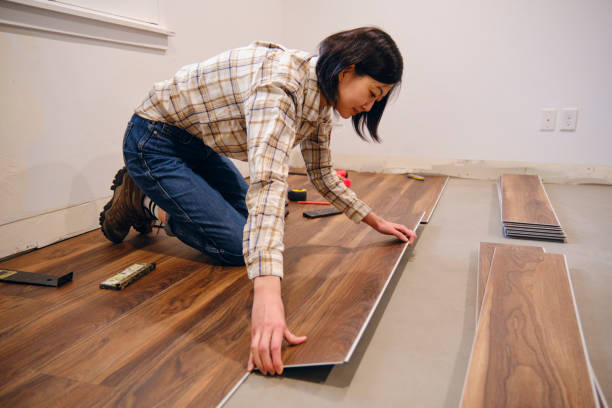
Cutting and Fitting Is Where Patience Matters Most
This is where the job slows down.
Every room has:
- Corners that are not perfectly square
- Door frames that require precise cuts
- Vents or obstacles in the flooring path
Each board has to be measured and cut carefully to fit naturally into the space.
There is no shortcut here. Even small errors become visible once the floor is complete.
Spacing, Expansion, and Why Wood Needs Room to Move
One thing homeowners often do not realize is that wood is not static.
It expands and contracts with humidity changes.
That is why expansion gaps are left along walls and fixed points.
Without those gaps, flooring can start to push against walls and create pressure that leads to buckling.
It is a simple detail, but it is one of the most important parts of the entire installation.
Finishing Touches Are What Make It Look Complete
Once the flooring is installed, the job is not finished yet.
Final steps include:
- Installing baseboards or trim
- Filling minor gaps if needed
- Cleaning surface residue
- Checking for loose or uneven boards
This is the stage where the floor starts to look like it belongs in the home instead of a construction project.
Common Mistakes Homeowners Make
If someone is attempting hardwood flooring for the first time, these are the issues that usually come up:
- Skipping subfloor preparation
- Not acclimating the wood
- Starting without a proper layout plan
- Ignoring expansion gaps
- Rushing cuts around edges
- Using wrong adhesive or nails
Most flooring problems do not appear immediately. They show up weeks later, which is what makes them frustrating.
So, Can You Install Hardwood Flooring Yourself?
Technically yes.
But the real question is whether it will look and perform the way you expect it to over time.
Hardwood flooring is one of those projects where experience matters more than tools. The difference between a good floor and a great floor is rarely visible on day one. It shows up months later when everything is still perfectly aligned and stable.
That is where professional installation makes a difference, especially for homeowners who want long term durability without guesswork.
Final Thoughts
Laying hardwood flooring is not just about placing boards on a surface.
It is about preparation, patience, and precision.
When done correctly, it becomes one of the most valuable upgrades a home can have. It adds warmth, style, and long-lasting value that homeowners feel every single day.
If you are planning a flooring upgrade in The Woodlands or surrounding Texas areas, GottaCallMAC helps homeowners with professional installation and renovation services that focus on durability, clean finishing, and long-term performance.
Because good flooring is not just seen.
It is felt every time you walk on it.
