
 Roofing Services
A deck is one of those parts of a home that quietly becomes the center of everything.
Weekend barbecues. Evening conversations. Family gatherings. Even simple mornings with coffee.
But over time, that same deck starts to show its age.
Boards loosen. Wood fades. Nails pop up. Some sections start feeling soft underfoot. And suddenly, what used to feel like a relaxing outdoor space starts feeling like something you need to “be careful” walking on.
That is usually the moment homeowners start thinking about repair.
And the first question is always the same.
Do I repair it, or is it too far gone?
Let’s break it down properly so you understand what deck repair actually involves in real life, not just in theory.
First, Understand What Kind of Damage You Are Dealing With
Not all deck problems are the same.
Some are small fixes. Others are warning signs.
Before doing anything, you need to look at the condition of your deck and identify what you are actually dealing with.
Common issues include:
- Loose or raised boards
- Cracked or split wood
- Wobbly railings
- Rusted nails or screws
- Faded or weathered surface
- Soft or spongy areas in the wood
- Water damage or rot
Each of these problems requires a different level of repair.
This is also where many homeowners realize that proper Home Renovation & Addons experience matters, because structural wood repairs are not just cosmetic fixes.
Safety Comes First, Even Before Tools
One thing people often overlook is safety.
A damaged deck is not just an appearance issue. It can become a structural risk.
Before starting any repair work, check:
- Stability of support posts
- Condition of joists underneath
- Railings for movement or weakness
- Any visibly rotting sections
If the structure feels unstable, it is better to pause and assess rather than rush into repairs.
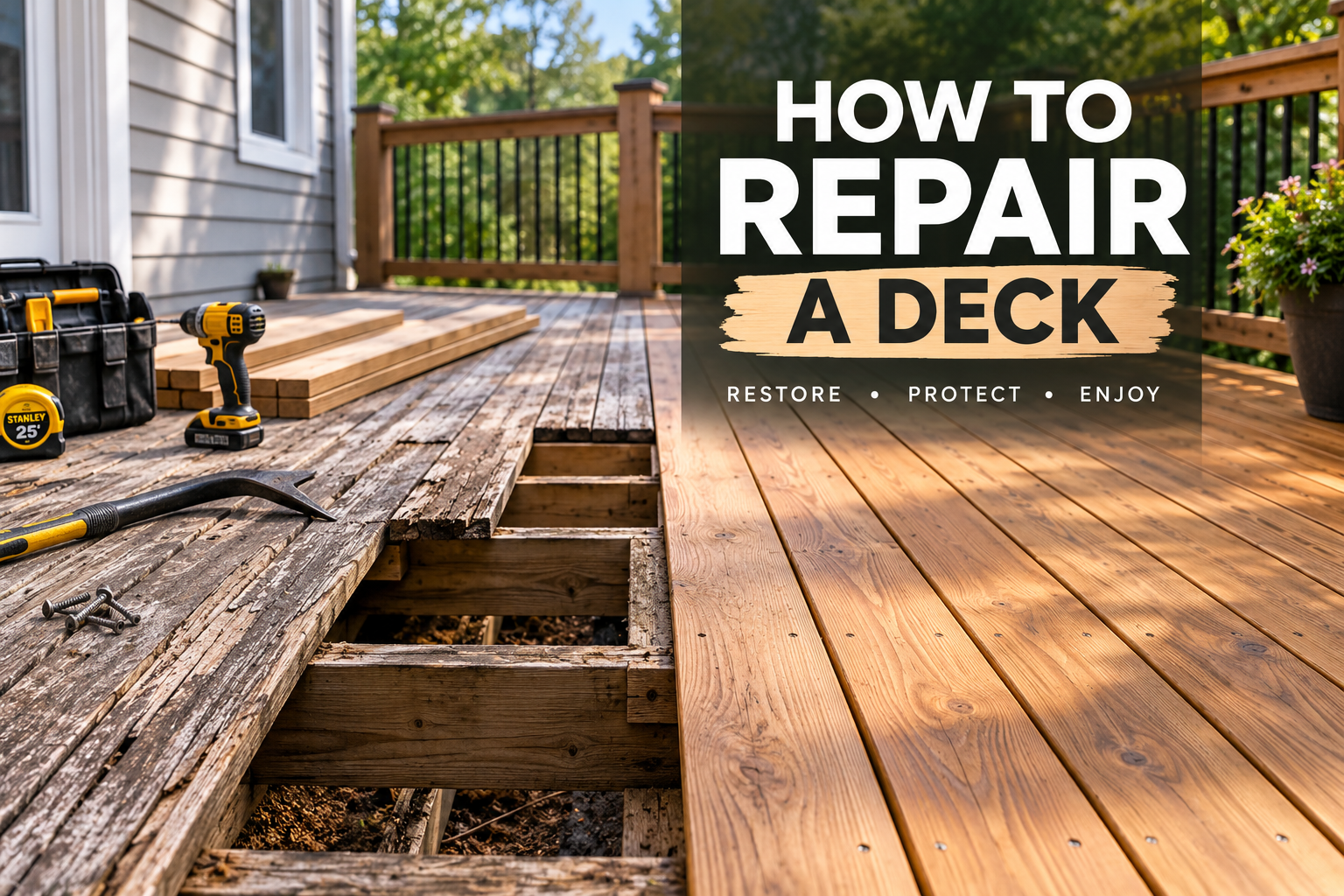
Step One: Replacing Damaged or Rotten Boards
Most deck repairs start at the surface.
If individual boards are cracked, warped, or rotting, they need to be replaced.
The process usually involves:
- Removing damaged boards carefully
- Checking underlying framing
- Cutting replacement boards to size
- Securing them with proper fasteners
One important detail here is matching wood type and thickness. Even small differences can affect the final look and feel of the deck.
Step Two: Fixing Loose or Raised Fasteners
Over time, nails or screws can start to loosen due to movement, weather, and wood expansion.
Loose fasteners can create tripping hazards and should be corrected early.
Repair usually involves:
- Removing old or rusted fasteners
- Re-securing boards with deck screws
- Ensuring flush surface alignment
This step seems small, but it makes a big difference in long-term durability.
Step Three: Repairing Structural Weak Points
This is where things get more serious.
If support beams or joists underneath the deck are damaged, surface repairs are not enough.
Signs of structural issues include:
- Bouncing or movement when walking
- Visible sagging areas
- Soft wood near support points
- Water damage around joints
At this stage, reinforcement or partial rebuilding may be required.
This is often where professional help becomes necessary because structural integrity is not something to guess on.
Step Four: Railings and Safety Barriers
Railings are not just decorative. They are a critical safety feature.
Loose or unstable railings should always be fixed immediately.
Common repair methods include:
- Tightening connection points
- Replacing damaged posts
- Reinforcing anchor points
- Updating hardware where needed
A railing should feel solid, with no movement when pressure is applied.
Step Five: Sanding and Surface Preparation
Once structural repairs are complete, the surface needs attention.
Sanding helps:
- Remove splinters
- Smooth rough areas
- Prepare wood for staining or sealing
- Improve overall appearance
This step also helps extend the life of the repair work by improving the wood’s absorption of protective coatings.
Step Six: Sealing or Staining the Deck
This is the step most homeowners underestimate.
Even after repairs, untreated wood is vulnerable to weather damage.
Applying a protective layer helps:
- Prevent moisture absorption
- Reduce sun damage
- Slow down future cracking
- Improve overall appearance
This is where Fence Staining experience often overlaps with deck care, since both rely heavily on proper wood protection techniques.
When Repair Is Not Enough Anymore
Sometimes, deck repair is no longer the best option.
You may need replacement if:
- Multiple support beams are damaged
- Rot has spread across large sections
- The deck feels unsafe or unstable
- Repairs are becoming frequent and costly
At that point, rebuilding is often more cost-effective and safer in the long run.
Common Mistakes Homeowners Make During Deck Repair
Deck repair looks simple until you are actually doing it.
Some common mistakes include:
- Replacing boards without checking the structure underneath
- Ignoring hidden moisture damage
- Using mismatched materials
- Skipping sealing after repairs
- Over-tightening fasteners and splitting wood
These mistakes often lead to repeated repairs within a short time.
DIY vs Professional Deck Repair
Small repairs like tightening screws or replacing a few boards can be handled by homeowners.
But when it comes to structural damage, uneven framing, or widespread wear, professional repair becomes important.
A trained contractor can quickly identify hidden issues that are not obvious on the surface.
This is especially important in outdoor environments like The Woodlands, where humidity and weather conditions can accelerate wood deterioration over time.
Final Thoughts
Repairing a deck is not just about fixing visible damage.
It is about restoring safety, stability, and usability so the space feels enjoyable again.
A well-maintained deck can last for years and continue to be one of the most valuable outdoor areas of a home.
The key is knowing when to repair, when to reinforce, and when to bring in professional help.
If you are considering deck repair or outdoor restoration in The Woodlands or nearby Texas areas, GottaCallMAC provides reliable home improvement services focused on structural safety, long-term durability, and clean finishing.
Because a deck should not just look good.
It should feel solid every time you step on it.
